
How AV Companies Quietly Over-Spec Your Event (And the Push-Back Script That Works)
I've watched AV quotes balloon from $18,000 to $47,000 on the same event with no additional requirement from my client. The over-spec playbook is systematic. Here's how to counter it.

I spent eleven years on the AV side of the table before I switched to consulting. I ran lighting and video at conferences from 50 to 3,000 people, mostly in the Bay Area and Pacific Northwest. I know the over-spec playbook because I used it. Not out of malice — I genuinely believed my clients needed what I was selling, most of the time — but with the benefit of now being on the other side, I can see the pattern clearly.
Let me describe it, and then let me give you the counter.
The over-spec playbook
Step 1: Anchor on a large scope quote.
The first AV quote you receive is almost always 30-40% larger than what the event actually requires. This is partly because AV companies price to their preferred setup — the one that’s easiest to execute and most profitable — rather than to the minimum requirement for your event. The first quote sets the psychological anchor. Everything you negotiate from that number feels like a win, even if the number it started from was inflated.
Step 2: Bundle the technical elements you can’t evaluate.
Audio processing equipment, signal routing, fiber runs, video switchers — these are the line items that clients can’t challenge because they don’t know what they are. A quote that says “Yamaha QL5 digital console, $850/day” sounds specific. You don’t know whether you need a QL5 or a smaller QL1. The difference is $400/day. Multiply that by a two-day event and you’ve spent $800 more than necessary on audio routing that sounds identical to your attendees.
Step 3: Add redundancy as a default.
Backup systems, redundant projectors, hot-standby equipment — all legitimate in the right context, all profitable additions to a quote. The question is whether your event actually needs redundant video switching or whether the AV company added it as a default because it’s easier to remove from a quote than to add during execution.
Step 4: Time the in-house comparison to your disadvantage.
Hotel AV vendors — the in-house AV companies that hotels contract with exclusively — know that you’re comparing them on price at a disadvantage. You’re comparing their bundled rate to an outside vendor’s quote, but using an outside vendor requires rigging fees, load-in coordination, and sometimes a hotel AV buyout fee that’s 15-30% of the outside vendor’s total. By the time you add those costs, the in-house quote looks competitive again. This math is often accurate — in-house is genuinely cheaper when you factor in all costs — but it’s also presented to you at the moment when you’re least equipped to verify it.
The over-spec event I remember most clearly
A 220-person product launch in San Francisco, 2022. My client’s initial AV quote from the hotel’s in-house vendor was $41,500. Two projectors, full line array audio, LED wall, stage lighting with a four-person crew, a production switcher, two confidence monitors, a streaming package, and full-day labor for a three-person team.
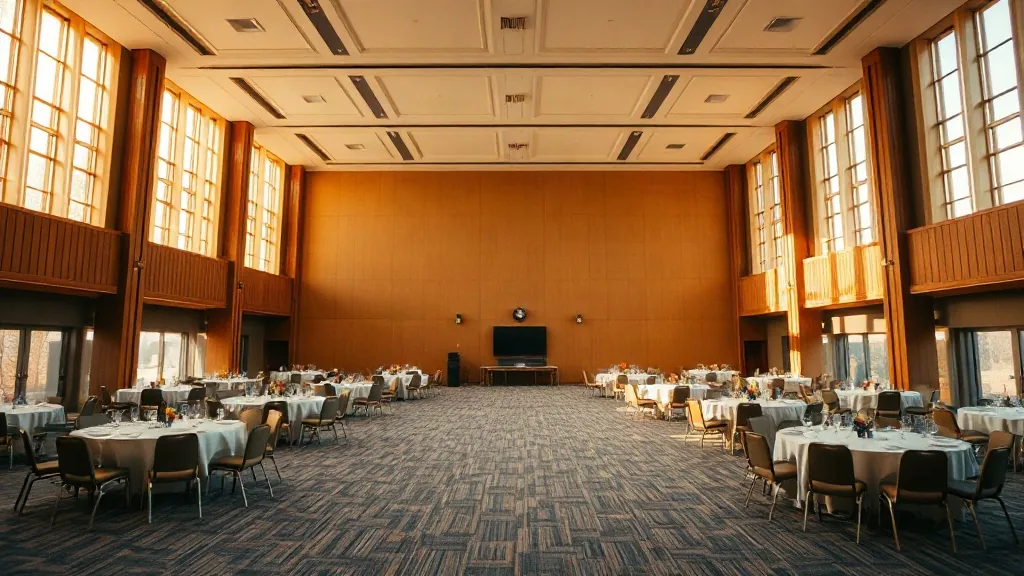
I walked through the spec. The event was a two-hour presentation with two speakers and a brief Q&A. No video playback beyond a slide deck. The “audience” was 220 people in a room that seated 250 — not a large format space.
Here’s what the event actually required: one projector or a 110” LED panel, a simple four-channel audio setup with two wireless handhelds and room fill, two confidence monitors, a laptop-input switcher, and two AV operators.
The minimum functional spec came in at $18,200. The gap was $23,300.
Not all of that gap was over-spec — some of the premium was for the in-house vendor’s guarantee and on-site responsiveness. But $10,000-15,000 of it was equipment the event didn’t need.
The push-back script
This is the actual language I use when reviewing AV quotes. You don’t need technical expertise to use it — you need to ask questions that force the vendor to justify each line.
“Walk me through this specific line item. What does this piece of equipment do, and what is the consequence to my event if we remove it?”
This question is the most powerful one you can ask. It forces the vendor to articulate the user-visible impact of each element. If they cannot explain it in plain language — if the answer is “it’s part of the standard package” or “you’ll want it for backup” — that’s a sign it can be removed or reduced.
“Show me the minimum functional spec for an event of this size and format.”
Ask directly for the stripped-down version. A good AV vendor will tell you: here’s what you can’t cut, here’s what’s optional, here’s what I’d add if your budget allows. A vendor who can’t produce a minimum spec is optimized for upselling, not for your event’s success.
“What is the streaming package actually delivering, and does my event need it?”
Streaming add-ons are the highest-margin AV line item in the market right now, priced for the hybrid-event moment that peaked in 2021-2022. If your event is in-person-only, you don’t need it. If there’s a recording requirement, ask whether the recording can be handled with a single fixed camera on a software capture rather than a full streaming production setup. For a 220-person internal meeting, the answer is almost always yes.
“Can we use the venue’s built-in speakers instead of a line array?”
Modern hotel ballrooms and conference rooms have built-in speaker systems that are often more than adequate for a presentation-format event under 400 people. The line array — the large hanging speaker clusters you see at concerts — is appropriate for a ballroom over 500 people with a live music component or a highly dynamic audio environment. For a 220-person meeting with two talking heads and a slide deck, the built-in system usually handles it and saves $4,000-8,000 in audio rental.
What to actually budget
For a presentation-format corporate event — two to four speakers, slides, Q&A, no entertainment — here are the rough benchmarks I use:
| Audience size | Minimum functional AV | Fully loaded AV |
|---|---|---|
| 50-100 | $3,500-6,000 | $9,000-14,000 |
| 100-250 | $7,000-14,000 | $18,000-32,000 |
| 250-500 | $14,000-25,000 | $35,000-60,000 |
| 500+ | $25,000+ | Negotiated |
“Fully loaded” means backup systems, LED wall, streaming, full production crew. “Minimum functional” means your event looks good, sounds good, and runs without incident using appropriate-scale equipment. For most corporate events, minimum functional is the right target.
If you’re planning an event in the Bay Area, San Francisco conference centers and meeting spaces in California often have competitive in-house AV because the market is large enough that venues have invested in quality built-in infrastructure. That doesn’t mean the quotes are right — but the starting point is better than smaller markets where the in-house vendor has less competition.
For multi-day conferences where AV is a significant budget line, I build a spreadsheet that lists every AV item separately, with the vendor’s justification and my challenge question for each. The spreadsheet creates a record of the negotiation and prevents the “but you approved the quote” conversation when I want to remove items. The Wi-Fi question belongs in the same negotiation — hotel ‘complimentary Wi-Fi’ is a separate scam that runs parallel to the AV over-spec problem and deserves its own contract language.
The honest note
Some AV over-spec is genuinely well-intentioned. AV vendors have been burned by equipment failures at critical events, and they build in redundancy because they’ve seen the alternative. A projector that fails mid-keynote is a career-defining moment for the AV team. The backup projector that added $800 to the quote exists because of that memory.
The question isn’t whether redundancy is valuable — it is. The question is whether the redundancy level is calibrated to the actual risk of your specific event. A CEO keynote at a $2M annual conference deserves hot-standby projectors. An internal department meeting for 80 people probably doesn’t.
Your job is to make that calibration explicit rather than accepting the default. The vendor’s default is set for the highest-risk scenario they’ve ever handled, not for the typical scenario you’re presenting.
If you’re thinking through the 8am general session timing alongside the AV setup requirements — start time and AV complexity are connected — the 8am-meeting industrial complex post covers why that session time is the wrong choice for most offsites and what it means for your production schedule.
Send me your AV quote. I’ll tell you which line items to cut.


