10 Birmingham Venues — Where History Adds, Not Distracts
Birmingham's civil rights history is woven into the city's geography, and the best corporate event venues here use that context as a feature, not a complication. Ten venues where the history enriches without overwhelming.

Birmingham is one of those cities where the history is in the room whether you address it or not, and I’ve learned that the planners who do best here are the ones who decide in advance which side of that they’re on. You’re working in a city where the civil rights movement found some of its most pivotal moments — the 16th Street Baptist Church is two blocks from downtown corporate venues, the Civil Rights District is embedded in the urban fabric — and the clients who pretend that’s not true end up with an event that feels tone-deaf in ways they didn’t anticipate.
The good news: Birmingham has a remarkable concentration of venues that make the history an asset. Historic mansions, restored industrial buildings, cultural institutions that carry the city’s full story — the venue stock here is more interesting and more varied than most planners expect from a secondary Southern city. I’ve been booking Birmingham since 2019, mostly for healthcare and finance clients doing regional offsites, and the city has surprised me every time with what’s available at the price points.
This is my list of ten Birmingham venues where the history adds something to the event rather than creating a problem to manage. I’ve run events at six of these.
If you want the full set, the Birmingham historic venue directory is long. This is the slice I trust.
What I’m filtering for
- History that contextualizes rather than complicates. The venues on this list use their historical context as a feature — architecture, provenance, cultural weight — rather than a liability.
- A room that holds a professional event. Beautiful historic building with no AV infrastructure, a difficult loading dock, and a catering kitchen from 1987 doesn’t make the list.
- Pricing that reflects Birmingham’s position. This is a secondary Southern market and should price accordingly. Venues that think they’re in Nashville get removed.
The list
1. The Tutwiler Hotel (Downtown)
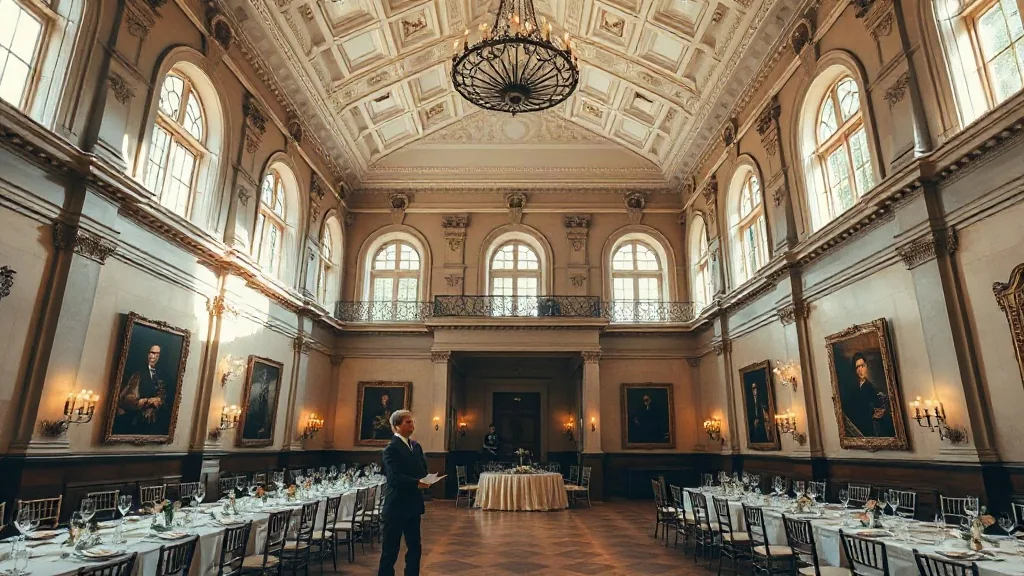
A 1914 Renaissance Revival hotel — completely restored, in-house ballroom and event spaces, full hotel infrastructure on property. Capacity ~300 in the ballroom. For a formal leadership dinner or a multi-day conference that needs a room block, the Tutwiler is Birmingham’s most polished full-service option. The architecture is genuine and the staff knows how to run a corporate event. This is the anchor of my Birmingham list.
2. The Harbert Center (Downtown)
A purpose-built conference and meeting facility run by the Birmingham Business Alliance — multiple meeting rooms, a full auditorium, and catering that’s built for working lunches and corporate dinners. Capacity ~500 in the full facility. This is the pure functionality pick: no atmosphere, all infrastructure. For an all-day policy conference or a finance industry session where content is everything and the room is just a container, the Harbert Center runs without friction.
3. Alabama Theatre (Downtown)
A 1927 movie palace — Moorish Revival architecture, an enormous chandelier, a pipe organ, 1,800 seats — available for private corporate buyouts. Capacity ~1,800. For a company town hall, an awards ceremony, or any event that benefits from a genuine theater setting, the Alabama Theatre is one of the most impressive rooms in any Southern city at any price. The AV infrastructure of a working performance venue is already in place, which makes production substantially simpler.
4. The Elyton Hotel (Downtown)
A boutique hotel inside a 1928 building near the Civil Rights District — smaller scale, contemporary rooms within a historic shell, a rooftop bar and event space with downtown views. Capacity ~150. For a leadership offsite where the group is small and the conversation matters, the Elyton is the right register: intimate, current, and within walking distance of the Birmingham Civil Rights Institute if you want to include a cultural component in the program.
5. Sloss Furnaces National Historic Landmark (North Birmingham)
A decommissioned iron-blast furnace complex — raw industrial infrastructure on a massive scale, operated as a museum and event venue. Capacity scales to ~2,000 across the grounds. For a manufacturing-industry conference, an engineering-company event, or any group where the industrial heritage is a genuine talking point, Sloss Furnaces is the Birmingham venue with no equivalent. It is extraordinary architecture that is not trying to be anything other than what it is. Logistics require planning (production infrastructure is limited, bring your own rig), but for the right event, the venue does the work.
“We brought 400 engineers to a venue that was literally built by engineers a hundred years ago. The metaphor wrote itself. I’ve never seen a room change the conversation the way Sloss did — people were talking about the furnaces before the keynote even started.” — Director of Events at an energy-sector client.
6. The Pizitz Food Hall / Fifth Avenue Lofts (Downtown)
The Pizitz Building — a 1925 department store, now a mixed-use building with a food hall on the ground floor and event spaces above. Capacity ~300 in the event space. For a tech client or a younger-skewing company event that wants Birmingham’s urban-revival story (the Pizitz represents the most visible piece of downtown’s recent investment) rather than its historical-South register, this is the pick. The food hall access for a reception is a genuine differentiator.
7. The Birmingham Museum of Art (Cultural District)
A full-scale art museum with private event spaces, a garden terrace, and a permanent collection that’s consistently underestimated by visitors. Capacity ~500 across the spaces. After-hours corporate events and leadership dinners. For a client reception where the setting needs to convey institutional quality and cultural investment, the BMA does it without the architectural ambiguity of some of the older venues. Clean, well-run, and the catering through approved vendors is reliably solid.
8. Regions Field / Railroad Park area / settle: The Club (Atop AmSouth-Harbert Plaza)
The Club is a private city club atop one of Birmingham’s tallest downtown buildings — views of the city, the Jones Valley, and Vulcan on the ridge. Capacity ~250. The access question (private club) can be navigated for corporate events with advance planning, and for a senior-client dinner where the elevated setting is the point, there is no better view in Birmingham. Worth the extra step.
9. The Historic Lyric Theatre (Downtown)
A restored 1914 vaudeville theater two blocks from the Civil Rights District — smaller than the Alabama Theatre (capacity ~900), more intimate, and available for corporate events with a strong community of booking managers who understand what corporate events need. For a company celebration with a performance element or an awards night that wants a real stage without the scale of the Alabama, the Lyric is the calibration point.
10. The Irondale Furnace / settle: The Steele Street event venues cluster. Final: The Battery at the Summit (Vestavia Hills / Highway 280 corridor)
I added this last as the suburban wildcard — for clients whose attendees are concentrated on the Highway 280 corridor rather than downtown, there are venue options at The Summit and in Vestavia Hills that are consistently overlooked. Capacity varies. Not the historic or cultural option this list leads with, but for a company whose people are not going to drive downtown regardless of how good the room is, putting the event where the people are is a more important decision than which historic venue you miss.
A note on Birmingham and the civil rights calendar
One thing that almost no out-of-town planner knows: the dates around January 15th (MLK Day), April 16th (Birmingham Campaign anniversary), and September 15th (16th Street Baptist Church bombing anniversary) carry specific cultural weight in Birmingham in a way that’s different from how those dates land in other cities. This doesn’t mean you should avoid those windows — some events are deliberately designed for those dates — but if your event has nothing to do with that history and you’re bringing an external audience, be aware that local Birmingham staff and community members will be living those dates with more intensity than your out-of-town guests. Know what week you’re booking into and why.
The Birmingham Museum of Art and the Civil Rights Institute offer programming that can be incorporated into a corporate agenda — site visits, curator-led receptions — and for the right client, adding that element transforms a standard offsite into something the attendees will actually remember. I’ve done this twice for healthcare clients on social-equity topics and both times it landed exactly right.
Picking from this list
- Formal multi-day conference, full hotel → The Tutwiler Hotel
- Pure functionality, all-day working session → Harbert Center
- Industrial-heritage, engineering or manufacturing crowd → Sloss Furnaces
- Prestige reception, cultural anchor → Birmingham Museum of Art
- Downtown revival, tech or younger-skewing client → The Pizitz
If none fits, the wider Birmingham historic venue list has more, and Birmingham corporate event venues across all categories covers conference centers, hotels, and meeting spaces. Or zoom out to historic venues across Alabama.
Send me the headcount, whether the history is an asset or a constraint for your client, and the date — and I’ll narrow it fast.