
The Corporate Holiday Party Playbook: Budget by Tier, Format by Headcount, and the Alcohol Calculus
Corporate holiday parties have a fixed budget ceiling, predictable format options, and one decision that determines everything else: how much alcohol, for how long, and who's accountable for what happens after. This playbook covers the $65-120 per-head budget band, the format decision tree by headcount, and the venue brief that produces a party people actually attend.

I planned my first corporate holiday party in 2017 for 140 people on a $9,200 budget. The CFO had approved $65 per head. The venue wanted $85 per head for a seated dinner. I spent two weeks trying to make the math work before I understood that the problem wasn’t the budget or the venue. The problem was the format.
Holiday parties have a fixed budget ceiling. Healthcare and financial services clients typically run $75-95 per head; tech and agency clients run $90-130 per head. Law firms and professional services firms go higher when equity partners are involved. Within your budget band, the format decision determines everything: the venue type, the catering structure, the entertainment, and how many people actually show up.
The format decision tree by headcount
Under 60 people: Restaurant private dining room with a prix fixe menu. This is the easiest format to execute and the hardest to screw up. Restaurants with private dining typically offer holiday buyouts with inclusive pricing of $85-135 per head covering food, a 2-3 hour wine and beer service, and room fee. You get better food than a banquet hall, no AV headaches, and a setting that doesn’t require decoration. The downside: no dancing, limited bar flexibility, and a room that’s designed for 2.5 hours, not 4.
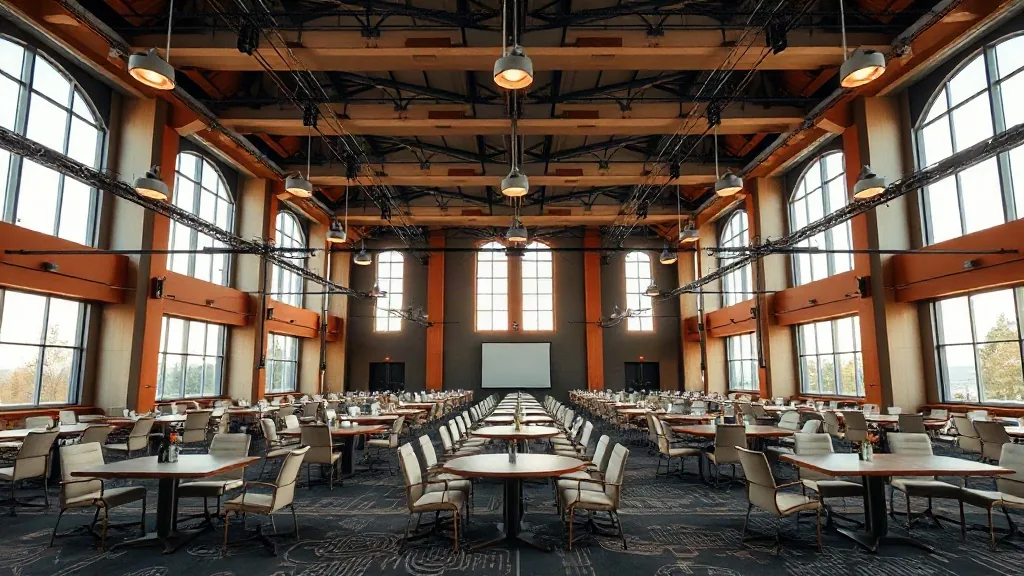
60-150 people: This is the hardest headcount range for holiday parties. You’ve outgrown restaurant private dining but you haven’t hit the size where a full venue rental makes sense. The options that work: a restaurant buyout (not just the private room, but the whole restaurant) for under 100, a bar-restaurant hybrid space with a reserved section, or a small event venue with its own bar infrastructure. Rooftop venues work well in this range from October to mid-November before weather becomes a variable. Banquet halls can work but need careful negotiation on catering quality because the hall’s base-level menu is usually the worst option on their offering sheet.
150-400 people: Dedicated event venue or hotel ballroom. This is the format where the party/dinner hybrid makes the most sense. Cocktail hour (6-7pm), seated dinner (7-8:30pm), dancing (8:30-11pm). You need a DJ or band, a dance floor cleared after dinner, and a bar that stays open through the dancing segment. This format works in a banquet hall with the right catering contract and a production budget of at least $8,000 for sound, lighting, and DJ.
Over 400 people: Convention or large event venue. The party format shifts: no seated dinner, stations and heavy appetizers, open bar, entertainment. Standing formats are more cost-effective per person ($60-85 all-in vs $90-130 for a seated dinner) and produce higher energy because people move around rather than anchoring to a table.
The alcohol calculus
The alcohol structure is the one decision that changes the liability profile of the event. I’m going to be direct about this because most holiday party guides are not.
Open bar, all night: Maximum cost ($25-45 per person for a 3-4 hour open bar), maximum liability. This is the format that produces overservice incidents. If you’re running an open bar at a holiday party, you need a licensed bartender (not just a server with a pouring permit) at every bar station, a visible water and food service operation throughout, and a transportation plan for attendees. The venue should have a liquor liability rider in the contract. You should have one in your event insurance policy. This isn’t optional.
Consumption bar with a cap: You prepay for a set amount of bar spend (e.g., $3,500 for a group of 75), the bar runs until the cap is hit, and then it closes or switches to cash. This is my preferred structure for clients who want to control liability without appearing cheap. The key is communicating the format correctly so guests understand the bar structure before they arrive.
Beer and wine only: A defensible choice for morning or early-afternoon holiday brunches. For an evening party with a dance component, beer-and-wine-only creates a “company didn’t trust us with liquor” dynamic that affects attendance and energy. If budget is the driver, a consumption bar is a better choice than restricting spirit selection.
Transportation: Any holiday party with a full open bar in a city where guests have driven to the venue needs a transportation option. This can be a ride-share subsidy (a code that covers up to $30 per person, distributed at check-in), a shuttle to a central hub, or a valet that delays car retrieval until the end of the night. Not providing it is not an option.
The venue brief
For a holiday party, I send this brief to every venue before I ask for pricing:
- Headcount (invited, not assumed attendees; I plan for 75-80% of invite list showing up)
- Date window (November 30-December 20 for most companies; first two weeks of December book 9 months in advance in Tier-1 cities)
- Format: standing cocktail vs dinner/dance vs seated dinner
- Bar structure: open, consumption, or beer-wine
- Entertainment: DJ, band, or none
- Budget per head: state it directly; venues that won’t share pricing until after a site visit are not worth the time
- Transportation: whether you need shuttles from the venue or a valet arrangement
One thing I always ask: what other events are you running that night? A holiday party that shares a building with another company’s party creates parking nightmares and elevator congestion. Confirm either exclusive venue use or separate entrance and egress.
What actually gets attendance up
Two things move RSVP rates for corporate holiday parties more than anything else: the day of the week and the plus-one policy.
Day of week: Thursday consistently outperforms Friday for attendance in my experience. Friday parties get attendance problems when employees have travel plans. Thursday is 20% higher attendance conversion at events I’ve planned.
Plus-one policy: Including spouses and partners increases attendance by 15-25%. The employees who decline solo party invitations often accept when they can bring a guest. The cost increase (additional per-head at $65-90) is offset by higher attendance, better room energy, and employees spending more time at the event. I have advocated for plus-one inclusion at every holiday party I’ve planned since 2019.
Banquet halls with flexible minimums and a willingness to negotiate plus-one pricing separately are the right category for most 100-350 person holiday parties. Get quotes from three in your metro area, compare the menu options at each price tier, and visit at least one before signing.
The entertainment decision
The default entertainment choice for a corporate holiday party is a DJ, which is the right choice for 60-70% of events. A DJ is flexible, lower-cost ($1,200-3,500 for a 4-hour set in Tier-2 markets), and produces consistent energy across different music preferences. The failure mode is a DJ who plays to their own taste rather than reading the room; your brief should specify playlist zones (dinner background, cocktail hour, dance floor) with specific examples.
A live band works better than a DJ when: the guest count is above 150, the budget allows for a 4-5 piece band ($4,500-9,000 in Tier-2 markets), and the company’s culture values visible effort and craft. Bands produce more energy variance: a strong band set is better than any DJ set; a band having a rough night is harder to recover from than a DJ.
Experiential entertainment (photo booths, caricaturists, casino tables, comedy performers) works as a supplement to background music, not as a replacement. A photo booth at a 200-person holiday party keeps guests engaged during dinner lulls and produces branded content. It’s not the main event. If entertainment is doing the heavy lifting of the party’s energy, the party doesn’t have enough energy on its own.
The entertainment decision should be finalized 6 weeks before the event for bands, 4 weeks for DJs, and 3 weeks for experiential add-ons. These lead times reflect vendor booking calendars in peak December season, not planning preference.
One more thing on rooftop venues for holiday parties: they’re a strong choice for October and November events but become complicated in December in most of the country. A rooftop holiday party in Chicago in December requires a heated tent, which adds $4,000-8,000 to the venue cost and eliminates most of the venue’s visual appeal. Know the weather risk of your region before booking a rooftop for any holiday date after Thanksgiving.
What’s your headcount, budget per head, and target date? Those three inputs narrow the format decision to two or three options.


