
How to Evaluate In-House AV vs Bringing Your Own Vendor: the 6 Decision Points
Hotel and conference center AV departments are convenient and expensive. Outside AV vendors are often 40 to 80 percent cheaper for the same equipment, but they require venue approval, load-in coordination, and a planner who knows how to manage the relationship. Here are the six questions that tell you which direction to go before you get a single quote.

I spent four years working for an in-house AV company at a 400-room conference hotel in the Bay Area. I know exactly how the markup works, because I built the quotes.
The standard formula was simple: take the outside market rate for each piece of equipment, add 50 to 80 percent, and present it as a bundled package with labor. A projector that rented for $350 per day from a local AV company showed up on our quote at $580. A 10,000-lumen laser projector that a production company would charge $1,200 for was $2,100 in our system. Labor was priced at $95 per hour for a technician who made $28 per hour with a full benefits load of maybe $38.
This is not corruption. It’s how hotel AV economics work. The hotel charges the AV company a fee to operate on-property (typically 40 to 60% of AV revenue), and the AV company has to recover that against real equipment and labor costs. The markup is structural.
Knowing that doesn’t mean you should always bring an outside vendor. Sometimes the in-house option is the right call. Here are the six decision points.
Decision point 1: Does the venue require in-house AV?
Some venues have exclusive AV agreements. These are most common at convention centers, large hotel properties with long-term in-house AV contracts (Marriott and Hilton properties often use PSAV or Freeman), and academic conference centers. If the contract says “exclusive AV provider” or “house AV required,” you have no choice. Negotiate the scope and pricing within the in-house system, or don’t book the venue.
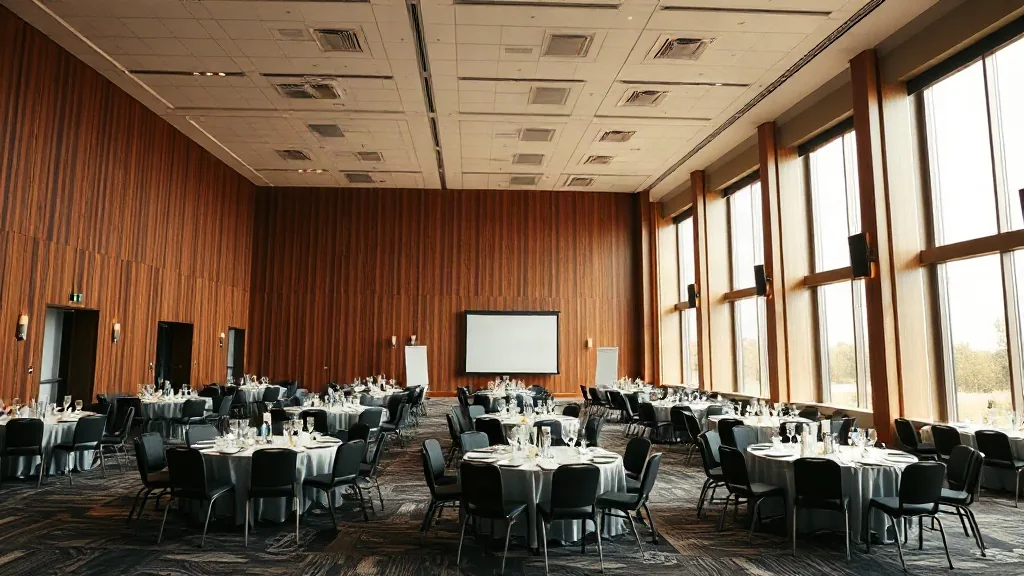
Before you start evaluating alternatives, read the venue contract for exclusivity language. If you sign without reading this and then try to bring an outside vendor, you’ll either breach the contract or spend 3 days negotiating a buyout.
Decision point 2: What is the markup gap in your specific case?
The markup varies by venue tier and by event type. For a straightforward 100-person presentation with two screens, one PA system, and two wireless microphones, the in-house quote might be $3,800 and an outside vendor might be $2,100. That $1,700 gap is real but manageable.
For a complex 400-person general session with LED walls, broadcast-quality streaming, and a full lighting rig, the gap widens. In-house might quote $65,000; an outside production company might quote $38,000. A $27,000 gap is a different conversation.
Get both quotes. Don’t assume the gap is large for simple setups or small for complex ones. In-house AV at some independent conference centers is competitive on straightforward work. In-house AV at large convention hotels is almost never competitive on complex production.
Decision point 3: What is the outside vendor approval process?
Most venues allow outside AV vendors but require an approval process. Typical requirements: proof of general liability insurance ($1M per occurrence minimum, venue named as additionally insured), load-in timing that doesn’t conflict with the venue’s other clients, and sometimes a kitchen-access or rigging-access fee of $300 to $800.
Ask the venue: “Do you allow outside AV vendors, and if yes, what is your approval process?” If they say yes, ask for the approval requirements in writing and give them to your outside vendor immediately. A vendor who has worked at that venue before already has the COI on file and knows the loading dock schedule. That experience is worth paying slightly more for.
Decision point 4: Is the rigging in-house or shared infrastructure?
This matters for events with hanging elements: lighting trusses, LED panels, projection systems with rear-projection screens. Rigging (attaching equipment to the ceiling grid or structural points) requires certified riggers at most venues, and venues often require their own riggers even when outside vendors supply the equipment.
In-house rigging fees run $150 to $400 per hang point. An event with 10 hang points could add $1,500 to $4,000 in rigging fees to an outside vendor’s quote, which can close 40 to 60 percent of the original cost gap.
Ask the venue: “If we bring an outside AV vendor, can their certified riggers hang from your grid, or do you require your in-house riggers?” The answer changes the math.
Decision point 5: What happens when something breaks?
In-house AV teams have spares on the property. When a projector lamp fails 30 minutes before a keynote, they walk to the storage room and bring a replacement. Outside vendors carry spares in their truck or call the nearest warehouse. In a tier-1 city with multiple AV houses, a replacement can arrive within 45 to 90 minutes. In a tier-3 city with one AV company that’s 40 miles from the venue, you’re waiting longer.

For high-stakes events, such as an investor day, a product launch with press, or a keynote with a live broadcast, the in-house AV team’s proximity to emergency equipment has real value. Factor that into the decision, not just the equipment cost.
Decision point 6: Is this a recurring venue relationship?
If you book the same hotel or conference center three to four times per year, the in-house AV team knows your recurring setup preferences, your lead planner’s communication style, and the quirks of the room. That institutional knowledge reduces your coordination burden and day-of risk. Switching to an outside vendor for cost savings makes sense for a one-time event; it’s a harder argument when the relationship has built-in efficiencies.
Conversely, if you’re producing an event at a venue you’ll use once, there’s no relationship premium to protect. Get the outside vendor quote and evaluate it cleanly.
The hybrid approach
For events at conference centers or hotels that allow outside vendors, the most cost-effective model is often a hybrid: use the venue’s in-house technician as on-site support (many require at least one house technician during your event), and bring your own production company for the equipment and lead technician. The in-house tech costs $85 to $150 per hour; the outside production company brings the equipment at market rate. You pay the venue requirement and capture most of the cost savings.
For events at theaters and performing arts centers, the house audio system and rigging infrastructure often makes outside AV unnecessary. The house system is designed for that room. Read more on how those venues work in how to book a theater or performing arts center for a corporate event.
What’s the venue, the event format, and the approximate headcount? Those three inputs will tell me whether the in-house quote you’ve received is within a defensible range or whether there’s a real savings case for going outside.


