
How to Scope AV for a Conference: the 8-Question Brief That Prevents a $30K Surprise
Most planners hand an AV vendor a headcount and a room name and ask for a quote. That produces a quote with a $15,000-to-$40,000 range, which is useless for budget planning. Eight specific questions define the production scope and narrow that range to within $3,000 before the first vendor call.

I’ve been on the AV side and I’ve been on the planner side. On the AV side, when a planner sends me a “200 people, hotel ballroom, need full AV” brief, I quote everything. Every possible screen. Multiple mics. Recording. Streaming. All of it. That quote comes in at $38,000.
Then the planner calls and says they budgeted $12,000. Then we renegotiate. Then they sign at $16,500 and we both wasted four hours.
The fix is on the planner’s side: answer eight questions before you contact a vendor. The answers define the scope, and scope defines the price.
Why AV quotes are so wide
A general session for 200 people in a hotel ballroom can cost $8,000 or $45,000 depending on the production format. An $8,000 setup is a single projection screen, one confidence monitor, one podium mic, two wireless handhelds, and in-house audio. A $45,000 setup is dual screens with IMAG cameras, a four-person crew, a recorded multitrack output, a switched livestream to 400 remote attendees, and a confidence monitor at every presenter position.
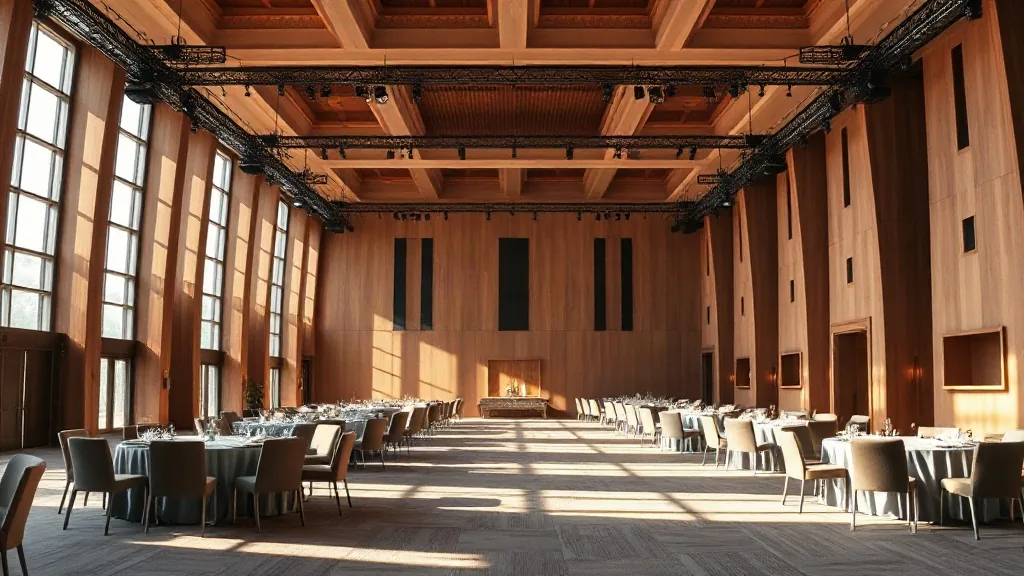
Both are “full AV for a 200-person conference.” Without the eight questions below, an AV vendor can’t tell which one you need.
The 8 questions
1. How many screens will be in the main room, and what is the screen format?
Single-screen setups are the default. Dual-screen is standard for rooms wider than 50 feet where sightlines to a center screen are poor. Triple-screen setups appear at 500+ person events and in rooms with column obstructions.
Screen format matters for resolution: a standard 16:9 HD screen takes a different projector and signal chain than a 32:9 ultrawide. If you want the screen to display branded content, speaker slides, and live video simultaneously in a divided layout, the AV company needs to know that in the brief, not on setup day.
2. Will there be IMAG (image magnification) cameras?
IMAG means a camera operator captures the speaker and projects their image live on-screen so back-row attendees can see facial expressions. For rooms over 150 feet in depth or events with 250+ attendees, IMAG is often worth the $4,000-8,000 it adds to the scope. For a 200-person room that’s 60 feet deep, it’s optional.
If you answer yes, the vendor needs to know: how many cameras, fixed or handheld, and whether you need a director and a technical director or just a single operator.
3. Will the event be recorded?
Recording has three sub-variants: a single-camera record of the program (cheapest, $800-1,500 for a 4-hour event), a switched multi-camera recording with production-quality cuts (adds $3,000-6,000), and a recording synchronized with the slide presentation for post-production distribution (adds another $2,000-4,000 depending on format).
Most planners say “yes, we’ll want a recording” without knowing which type. The answer changes the quote by $5,000-10,000.
4. Will the event be livestreamed?
Livestreaming adds encoder equipment, a dedicated internet circuit (venue WiFi is never sufficient; budget $800-1,500 for a hardwired dedicated circuit), a streaming operator, and a platform cost. A basic one-camera stream to a YouTube link is $2,500-4,000 additional. A produced stream with lower-thirds graphics, multiple camera cuts, and a streaming platform with attendee management is $8,000-15,000 additional.
Also answer: will remote attendees participate via Q&A or polling? That adds a Slido or Pigeonhole license and a moderator function.
5. How many microphones do you need, and what types?
The standard conference setup is one podium mic, two wireless handhelds for Q&A, and one lavalier for a keynote speaker. For a panel of five, add four more lavaliers. For a town hall with a roving Q&A across 200 seats, add a second roving mic and an additional operator.
For conference centers with in-house audio systems, the mic count may be limited by the number of available wireless frequencies. Ask before you spec.
6. What are the lighting requirements beyond basic stage wash?
Basic stage lighting (a wash that makes the speaker look presentable on camera or on-screen) is usually included in an AV quote. What adds cost: branded LED backlighting in your company colors ($1,500-3,000), a moving-light rig for an awards ceremony or product launch ($4,000-8,000), or followspots for a keynote with a moving presenter.
If your event has a pre-dinner cocktail hour in the same space with a different aesthetic, lighting resets add time and labor.
7. What is the room layout and where is the staging positioned?
Send the floor plan. AV vendors need to know: where the stage is, where screens will be suspended or ground-supported, where the mix position (audio console) will be placed, and whether there are rigging points in the ceiling.
At hotels and resorts, rigging points in a ballroom are often limited to four anchor points with a 500-pound load limit each. At purpose-built convention centers, rigging capacity is much higher and more flexible. If you’re planning aerial screens or significant trussing, the venue’s rigging certification is a factor in your AV scope.
8. Who is responsible for breakout room AV?
General session AV is usually one vendor’s scope. Breakout rooms are often separately quoted, with each breakout needing a projection screen, a projector or display, and at least one wired or wireless mic. For a conference with six breakout rooms simultaneously, that’s six additional AV setups. Budget $800-2,000 per breakout room depending on size and scope.
Confirm whether the main AV vendor is quoting breakouts as part of the general session package or whether those are a separate line. If they’re separate, get them included in the initial quote so you have a complete picture.
What to do with the answers
Write the answers in a single document and send it with your RFP to AV vendors. Ask for an itemized quote, not a package price. An itemized quote lets you see exactly what you’re paying for each component and trim the line items that aren’t essential to your specific event.
When you get three quotes based on the same eight answers, they’ll be within 15% of each other. That’s a competitive range you can negotiate from. A vague brief produces quotes that vary by 300%.
The in-house AV decision
If the venue has an in-house AV provider (common at hotels), you’ll receive their quote as part of the BEO. For small setups (one screen, one projector, two mics), in-house is often adequate and avoids the outside-vendor access fee. For setups that involve IMAG, recording, or livestreaming, in-house hotel AV teams are often understaffed and overpriced for production-quality work. Use the eight-question brief to get an outside quote and compare it against the in-house quote line by line.
The difference on a production-level setup is typically $8,000-18,000 in favor of the outside vendor. If the venue charges an outside vendor access fee (common: $500-2,500), factor that in but it rarely closes the gap.
What’s your conference format and attendee count? Share those and I’ll tell you which of these eight questions are most likely to affect your budget.


