
The Real Estate Developer Hosting the Project Launch Party: the Address-as-Venue Trap
Developers routinely hold launch events in unfinished or construction-adjacent spaces because the address is the marketing. Six specific safety, insurance, and catering problems arise when you treat a development site as an event venue, and each one is preventable with a specific mitigation.

The developer wants to host the launch party for their new mixed-use tower at the building itself. The penthouse isn’t finished. The lobby is operational. The rooftop is accessible but unlicensed. This is the scenario that generates more day-of crises per dollar of event budget than any other in my experience, and the reason is straightforward: the developer is optimizing for marketing impact and treating event logistics as an afterthought.
The address is compelling. The venue is often not ready. Here are the six problems that show up most reliably, and what you can do about each.
Problem 1: Certificate of occupancy gaps
A building under construction, in fit-out, or in partial-certificate-of-occupancy status creates real liability exposure for an event. Most comprehensive general liability policies exclude events at properties without a full CO. If someone falls on an unfinished floor, slips on a construction surface, or is injured by a loose railing, the event’s liability insurance may not cover it.
Before confirming the event at the development site, get a copy of the current CO or TCO (Temporary Certificate of Occupancy) and confirm which floors and areas it covers. Forward it to your event insurance broker and ask explicitly: is the event covered at this address under this CO status? If the answer is no or uncertain, either move the event or obtain a site-specific special events policy that covers the gap.
Problem 2: Catering infrastructure doesn’t exist
Development sites don’t have commercial kitchens. They may have residential kitchens in unit models that are not licensed for commercial food service. They have loading docks designed for construction materials, not for catering trucks. And they almost never have the power capacity for a commercial warming setup, a full bar service, and AV simultaneously.
The caterer you’re bringing in needs to understand this before they write the proposal. Walk the caterer through the space, specifically the kitchen access or lack of it, the distance from the loading dock to the service area, and the power capacity in the event space. A caterer who proposes a plated dinner with hot service at a site without a functioning kitchen is quoting a job they can’t execute. For development-site events, food stations, room-temperature service, and pre-packaged items (cheese boards, charcuterie, passed hors d’oeuvres from insulated carriers) are the realistic catering formats.
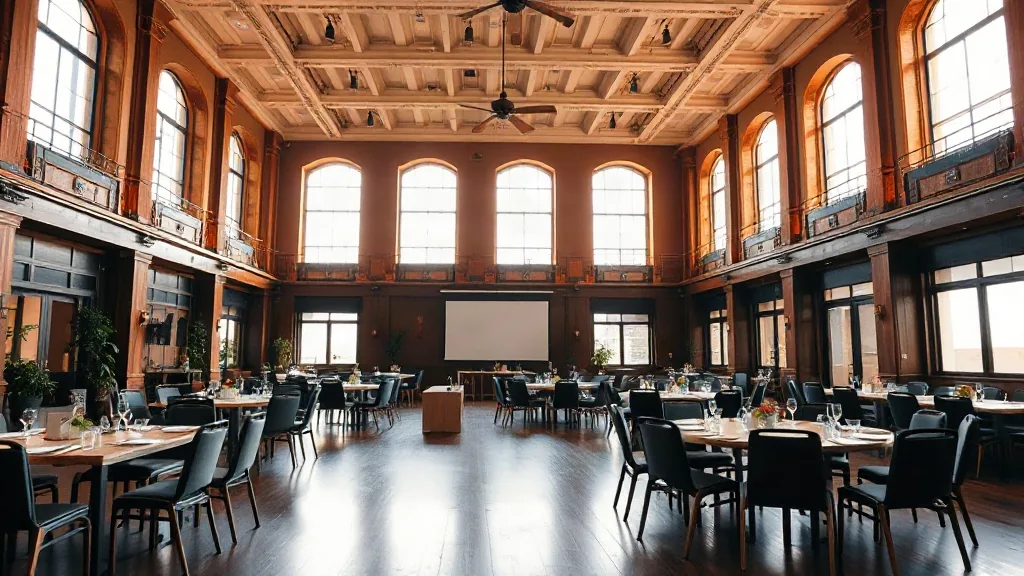
For a high-profile developer launch at a loft or industrial property with similar constraints, this is a solved problem: specialized event caterers who work blank-space events know how to execute without a kitchen. The markup for this service is real (typically $15-$25/head above standard catering for the infrastructure complexity), but it produces a professional result.
Problem 3: The rooftop is not licensed for events
Developers frequently assume that access to a rooftop automatically means the rooftop is usable as an event venue. It doesn’t. In most US cities, a rooftop used as an event space requires a specific occupancy authorization that is separate from the building permit and the CO. Rooftop venues that regularly host events have this authorization. A construction project with a recently completed rooftop deck almost certainly does not.
Using an unlicensed rooftop for an event with 80+ guests creates a code violation, a liability exposure, and a risk that a fire marshal or building inspector shuts down the event. If the rooftop is part of the developer’s marketing concept for the event, engage the city’s building department at least 90 days before the event to understand the temporary use permit process. Most cities have a process. It takes time.
Problem 4: Power and electrical systems are not commissioned
New construction and partial-completion buildings often have electrical systems that are live but not fully commissioned or inspected for event loads. A 200-person event with AV, catering equipment, and lighting draws 30-60 amps continuously. If the building’s electrical panels aren’t properly labeled, if breakers trip unexpectedly, or if shared circuits between units aren’t isolated, you’ll have equipment failures during the event.
Hire a licensed electrician to walk the venue two weeks before the event and confirm the following: the circuits serving the event space are capable of the projected load, each circuit is properly labeled, and the panel is accessible during the event with someone who knows which breaker corresponds to what. This costs $300-$600 for a 3-hour walk and confirms whether you have an electrical problem before 200 guests arrive.
Problem 5: Restroom facilities don’t meet code for the event headcount
Construction restrooms (portable toilets) are not appropriate for a developer launch event. Permanent restrooms in the completed portion of the building may not be in ratio with the guest count. Most jurisdictions require one fixture per 40-75 guests depending on the event type and duration.
Count the permanent restroom fixtures accessible to the event space. If they don’t meet the ratio for your guest count, rent temporary luxury restroom trailers and place them in the loading dock or parking structure adjacent to the building. This costs $1,200-$2,500/day and eliminates a significant complaint category.
Problem 6: Elevators are not rated for event load in construction-mode operation
A building with 200 event guests all arriving within a 45-minute window puts significant demand on elevator systems. In a partially completed building, some elevator banks may be reserved for construction use or not rated for passenger service. Confirm with the building’s facilities manager which elevators are available for guest use, what the rated capacity is, and whether there is a dedicated operator for the event. Without an operator, you’ll have guests waiting 8-12 minutes for elevator service during peak arrival and departure.
If the building can’t provide adequate elevator service for the guest count, consider a ground-floor venue format that doesn’t require elevator access, or limit the event to a guest count that the available elevator capacity can serve.
The alternative that preserves the address
If the development site has too many unresolved infrastructure gaps to serve as the primary event venue, consider using it as the event’s destination rather than its venue. Host the event at a nearby rooftop venue or loft venue and incorporate a 30-minute guided walkthrough of the development site as an activity. Guests get the address as an experience, not as a venue with inadequate restrooms.
This approach is more work but it separates the event logistics (managed by a competent venue) from the project marketing (the walkthrough of the development). The developer gets the moment they wanted. The guests get a professional event experience. And nobody is standing in a construction-adjacent space wondering where the bathroom is.
What’s your venue address, guest count, and event format? I can help you identify the specific code questions and the event venue category that might work better than the development site if the gaps are too large to close.


