
What Is an F&B Minimum and How Is It Different From the Catering Bill
An F&B minimum is a revenue floor the venue must hit, not a cap on your spending. Service charges and tax do not count toward it. Here is how the math actually works.

A client called me two weeks before her company’s holiday party convinced she had budgeted correctly. She had a $12,000 F&B minimum at a hotel ballroom and had planned a menu totaling $11,800. She thought she was $200 under.
She was actually $2,900 short. The $11,800 was the food-and-bar cost before service charge. The service charge at that hotel was 24%. The minimum required $12,000 in pre-service-charge, pre-tax food and beverage spend. Her menu got her to $11,800. She needed another $200 in food to hit the floor. Simple.
But wait. The service charge on $12,000 at 24% is $2,880. Then tax. Her actual bill was going to be closer to $16,500 regardless of the minimum. She had planned a $12,000 event and was facing a $16,500 bill. That’s the F&B minimum explained in one real scenario.
What an F&B minimum actually is
An F&B minimum is a guaranteed revenue floor that you commit to spending on food and beverage in exchange for the venue providing the event space, often at no additional room rental fee. It is not a budget cap. It is not the total you’ll spend. It is the minimum pre-charge, pre-tax food-and-beverage spend the venue requires to make the booking worthwhile.
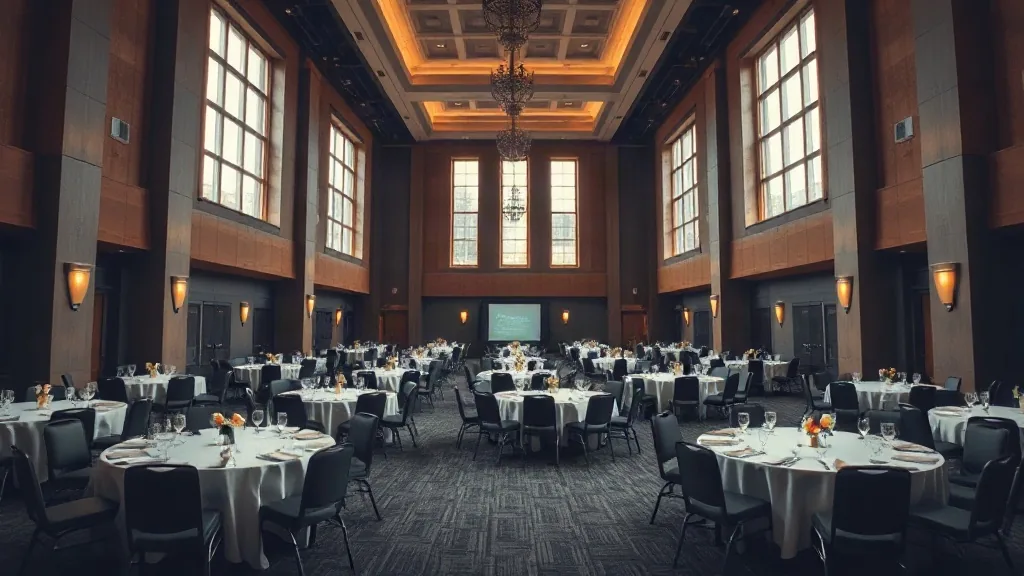
Hotels and hotel-affiliated venues use F&B minimums most frequently. The logic is straightforward: a hotel is giving up event space that could be used for other revenue-generating purposes. The F&B minimum ensures they make enough money on food and drinks to justify the room.
Standalone event venues, conference centers, and non-food-primary spaces usually charge a flat room rental instead of an F&B minimum. When you see a “complimentary room” in a proposal from a hotel, that complimentary room comes with a minimum attached.
Why service charge doesn’t count
This is the part that catches nearly every first-time planner.
Service charges are typically 20-26% of food and bar spend. They are charged by the venue on top of the per-head food cost. They cover event staff wages, linens, kitchen overhead, and, at many venues, some profit margin. They are not a gratuity in most cases. (The distinction matters and I wrote a whole post about it here.)
The F&B minimum is almost always stated as a net food-and-beverage figure before service charge and tax. So a $15,000 F&B minimum means you must spend $15,000 on food and drink, not counting service charge or tax. The total bill with service charge and tax could be $20,000 or more.
Venues word their minimums differently. The contract may say “food and beverage minimum of $15,000 plus applicable service charges and taxes.” Read that sentence carefully. The minimum is $15,000. You will spend considerably more.
The room rental trap
Some venues offer a choice: pay a flat room rental fee, or waive the room rental in exchange for a higher F&B minimum. The pitch is that the minimum feels less like a real cost because you might spend that on food anyway.
Do the math before you choose. If the room rental is $3,500 and the F&B upgrade minimum adds $5,000 to what you’d otherwise spend, keep the room rental. If the minimum adds $2,000 and saves you a $3,500 room charge, take the minimum.
The only way to evaluate this is to build a realistic food-and-beverage budget first, then compare it to both options. Venues count on planners choosing the minimum without doing that calculation.
What counts toward the minimum
Generally: food, non-alcoholic beverages, alcoholic beverages. Sometimes: coffee service, water station service. Rarely: equipment rentals, AV, linens, or setup fees.
If you’re planning to bring in a specialty cake, an outside caterer supplement, or non-venue bar products, those will not count toward the minimum. Check your contract language before making those decisions.
How to use the minimum as a negotiation lever
You are essentially promising revenue. Venues want that promise met or exceeded. If your event is in a slow period, on a weekday, or during a month when the venue typically has low occupancy, you have more leverage to negotiate the minimum down.
The ask: “Our group typically runs conservative on alcohol. Can we structure the minimum at $X and agree on a menu that gets us there without padding?” A catering manager who wants to book the date will often agree to a lower minimum with a clear path to meeting it.
For longer negotiation script examples, see the F&B negotiation script for the second call.
A worked example, start to finish
80-person corporate dinner at a hotel in Tampa. F&B minimum: $9,600. Menu: three-course plated dinner at $95/head (800 service plus pre-dinner reception with passed appetizers). Service charge: 23%. Tax: 7.5%.
Step one: 80 guests at $95 = $7,600. Reception appetizers for 80 at $18/head = $1,440. Dinner beverage service (non-alcoholic included, hosted bar calculated separately): assume $8/head = $640. Bar estimate: 3 drinks per person at $12 average = $2,880.
Total pre-charge, pre-tax: $7,600 + $1,440 + $640 + $2,880 = $12,560. Minimum is $9,600. You’re clear.
But the total you actually pay: $12,560 times 1.23 (service) times 1.075 (tax) = $16,582.
The minimum was $9,600. The bill is $16,582. Both figures are correct. They measure different things.
What happens if you don’t meet the minimum
If your actual pre-service-charge, pre-tax food-and-beverage spend falls short of the minimum, the venue will invoice you for the shortfall. This is not a penalty in the legal sense. It’s a charge for the difference between what you promised and what you spent.
Example: your minimum is $14,000. Your group spends $11,500. The shortfall is $2,500. The venue bills you $2,500, plus service charge and tax on that shortfall amount in many cases. Yes, you can pay a service charge on food you never ordered.
Whether service charge applies to the shortfall depends on your contract language. Most hotel contracts I’ve reviewed include language like: “Any shortfall below the minimum shall be charged at 100% of the applicable rate plus service charge and taxes.” That means the $2,500 shortfall becomes $2,500 times 1.23 times 1.075 = $3,305.
Read the shortfall clause. Ask specifically: “If we fall short of the minimum, is the shortfall charged at net or does it include service charge and tax?”
How to build a menu that hits the minimum reliably
The most reliable approach: build your menu from the most expensive items that your group will actually consume, then add contingency items that are easy to add late but don’t require significant preparation changes.
For a dinner event: start with the entree, add a first course and dessert, then calculate the bar. If you’re close to the minimum at that point, upgrade a single component (better dessert, add passed hors d’oeuvres at cocktail hour, upgrade bar to premium tier) rather than adding courses nobody needs.
Upgrade the bar last. Bar upgrades generate the most visible value to guests and are easy to add at the final BEO stage when you know you’re slightly under minimum. Adding a premium whiskey selection or a wine upgrade from house to reserve tier can add $8-15 per head to your spend with essentially no operational complexity.
The question to ask the venue
“Does the F&B minimum in this proposal represent the pre-service-charge, pre-tax food and beverage spend required?” Then ask them to confirm in writing that service charge and tax are not credited toward the minimum. Most venues will confirm this without hesitation. If they hesitate, that’s a red flag.
You’re booking at a hotel or resort, banquet hall, or restaurant private dining room. Before you finalize the budget, tell me the minimum and I’ll help you work backward to a menu that meets it without padding.


