How to Book a Banquet Hall for a Corporate Event
Banquet halls are the most commoditized venue category in the country, which means there's a huge quality range and a lot of room to negotiate. This guide covers what separates good halls from bad ones, how to compare proposals accurately, and where most planners leave money on the table.

Banquet halls get underestimated by planners who’ve seen too many mediocre ones. The format produces a flat booking environment: high volume, formula pricing, predictable menus. That’s also what makes it the most negotiable venue category in the country. I’ve booked banquet halls for corporate galas from $40 per head to $140 per head, and the difference wasn’t always in the food.
What a banquet hall actually is
The term covers a wide range: freestanding event buildings, hotel ballrooms operated on a banquet model, attached reception facilities at country clubs or restaurants, and multipurpose community centers that handle corporate bookings alongside bar mitzvahs and quinceanieras.
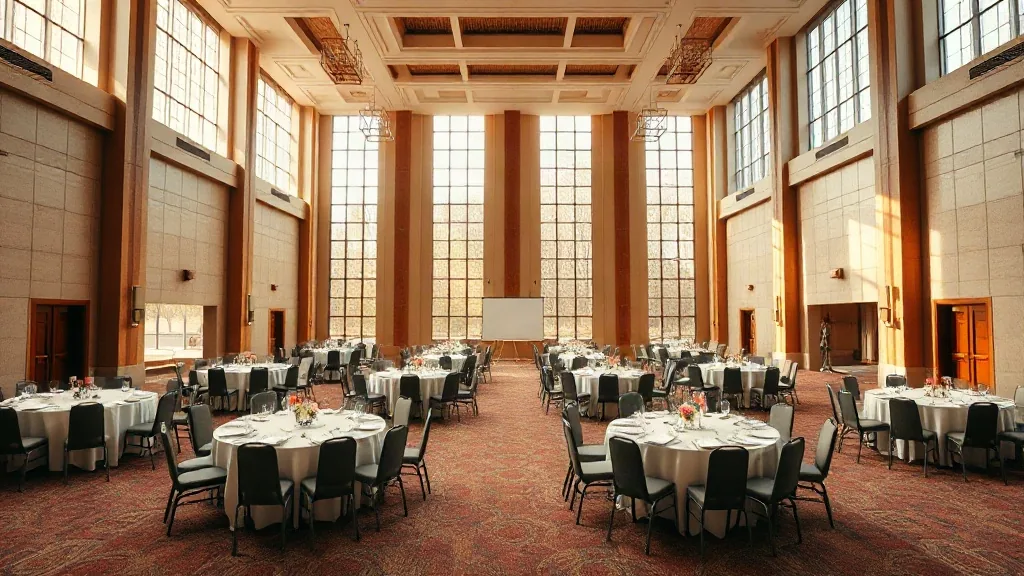
For corporate purposes, the useful definition is any purpose-built event space with in-house catering, full-day access, tables and chairs as standard equipment, and a defined minimum spend. That distinguishes a banquet hall from a loft (no in-house kitchen), a restaurant private dining room (usually under 100 seats), and a hotel meeting room (minimal catering infrastructure).
The in-house kitchen is the feature that makes a banquet hall work. It means your catering is tied to one vendor, which limits flexibility but simplifies coordination. The trade-off is worth it for most corporate events above 80 guests where managing an outside catering operation adds meaningful logistical complexity.
What makes one worth the price
Banquet halls at the same nominal price point differ on five factors:
In-house kitchen quality. Some banquet halls have full production kitchens capable of plated dinners for 500; others have warming kitchens that can handle buffet service for 300. Ask whether they cook on-site or bring food in from a commissary. On-site cooking correlates with better food quality and more menu flexibility.
Owned AV infrastructure. A hall that owns its projector, screens, speakers, and microphones will quote you an AV package at a fraction of what a third-party AV company charges. A hall that contracts out AV is functionally a blank space for production purposes. Ask what’s included in the room rental before comparing prices.
Full-day or time-blocked access. Some halls rent in 4-hour blocks; others give you the room from setup through breakdown. Full-day access matters for corporate events that have a morning setup, afternoon programming, and evening dinner. Blocked access means you’re paying two rentals or coordinating a compressed load-in.
Parking. In suburban markets, on-site parking is standard. In urban markets, it’s a negotiation point. Some halls have dedicated lots; others depend on street parking or adjacent garages you’d need to validate. For 200 attendees, parking for 80 to 100 cars is a real logistical need.
Staff-to-guest ratio. This is the differentiator you can only find by asking directly. A well-run banquet hall staffs at 1 server per 15 to 20 guests for plated service. Some halls staff at 1 per 25 or 1 per 30 to protect their margin. The difference shows up in service pace and plate quality. Ask the catering manager directly: what’s your server ratio for a plated dinner?
How to compare proposals accurately
Three halls will send you three differently formatted proposals and the numbers won’t compare directly. Here’s the normalization framework:
-
Convert everything to per-person cost. Venue fee, F&B minimum, AV package, setup fees, all of it divided by your confirmed guest count.
-
Confirm what the F&B minimum covers. A $150 per person F&B minimum with 22 percent service charge and 7 percent tax becomes $195 per person all-in. A hall with a $175 per person package with tax and service included is actually cheaper.
-
Identify what’s not in the proposal. Labor charges for setup and breakdown, parking validation fees, linen upgrades, cake cutting fees, and coat check staff are all common add-ons that some halls include and others don’t.
-
Confirm the AV inclusion. If a hall quotes “complimentary AV,” confirm specifically what that means: one screen, one projector, one wired microphone? Or a full sound system with wireless mics and a production board? These are not equivalent.
Where planners leave money on the table
F&B minimum vs actual spend. If your event is likely to hit the F&B minimum naturally with dinner and open bar, the minimum is a floor, not a ceiling. But if you’re running a dry event or a light reception, you can sometimes negotiate a lower minimum in exchange for a venue fee or a shortened rental window. Ask.
Day-of-week pricing. Banquet halls price Friday and Saturday at a premium. A Thursday evening event at the same hall can run 15 to 25 percent less on the F&B minimum. For corporate events, Thursday works.
Off-season rates. January and February are the softest months for banquet halls nationally. If your event can move to the first quarter, the negotiating position is materially better.
Menu substitution. Package menus are starting points. Ask which items can be substituted at the same price tier. Most halls will swap proteins and starch options without a cost difference; some will upgrade appetizers for a nominal per-person add.
The service-charge disclosure issue
Read the contract language for service charge and gratuity as separate line items. Service charges at banquet halls (typically 20 to 24 percent) go to the house, not to the servers. A separate gratuity line, if present, goes to staff. If your contract doesn’t have a separate gratuity line, the servers are not guaranteed to see any of the service charge.
I ask every banquet hall to confirm in writing how the service charge is distributed. About half of them will add a gratuity line at my request; the other half won’t, and I factor that into my assessment of the venue.
Day-of contact and escalation
One thing that separates well-run banquet halls from the rest: a named day-of contact who has authority to make operational decisions during your event. Not a banquet captain who takes instructions from an absent manager. A senior operations person who can authorize a menu substitution, resolve a vendor conflict, or give you overtime access at a moment’s notice.
Ask who your day-of contact will be and confirm they’ll be on-site from load-in through end of service. Get their cell phone number in writing before the event. A banquet manager who’s hosting two events simultaneously and can’t be reached when the AV fails is a problem you can avoid by asking this question upfront.
At halls where you’ve built a relationship over multiple bookings, this contact is usually consistent and already knows your preferences. At first-time bookings, it’s worth spending 10 minutes on a pre-event call to introduce yourself, walk through your run-of-show, and confirm they’ve received all vendor COIs and the BEO is accurate.
Browse banquet halls available for corporate events to search by city and capacity, or look at the event venues directory for standalone venues with more flexibility and more coordination required.
For a direct format comparison, Banquet Hall vs Restaurant Private Dining Room for 100 Guests breaks down when a restaurant private room wins on service quality. For awards-format events at banquet halls, the Industry Awards Ceremony Playbook covers the specific run-of-show considerations.
What’s your headcount, date, and whether you need AV? Those three factors define which type of banquet hall is the right fit for your event.