
General Session vs Breakout Room: Venue Terminology for Conference Planners
A general session is the main plenary space for the full group. Breakout rooms are smaller simultaneous spaces for sub-groups. The capacity ratio, AV requirements, and setup differences between them shape the whole conference.

Most conference venues quote you two line items: general session room and breakout rooms. Planners new to multi-session conferences nod along without fully understanding what those terms mean operationally. By the time they realize the general session room can’t accommodate their full group in the setup they wanted, or that the breakout rooms are 30-foot hallway alcoves with no AV, they’ve already signed.
These are not interchangeable spaces. They have different AV requirements, different capacity calculations, and different setup logic. Understanding the distinction before you negotiate saves you from building a conference that doesn’t work in the rooms you have.
What the general session is
The general session, also called the plenary session or main hall, is the space where all attendees gather simultaneously. It is the anchor of any multi-session conference: the opening keynote, the closing presentation, the awards ceremony, the annual meeting vote.
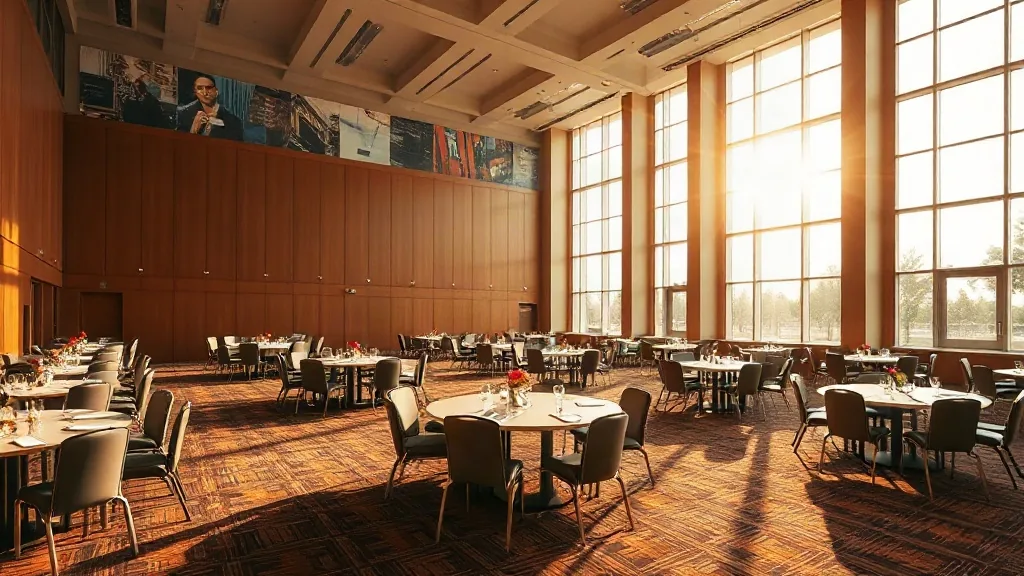
General session rooms are sized for your full attendee count in a theater or classroom setup. Theater setup (chairs only, no tables) is the most space-efficient and is standard for keynote-style programming. Classroom setup (chairs plus writing surface) requires roughly 40% more floor area per person because tables take up space chairs don’t.
A general session for 300 people in theater setup needs approximately 2,700-3,000 square feet of clear floor space. In classroom setup, budget 4,000-4,500 square feet for the same 300 people. Most conference venues publish capacity numbers in theater style. Always ask for the classroom-setup capacity if you need tables.
What AV the general session needs
General sessions require the most complex AV setup of any room type. The standard components:
Main screen: Typically one screen per 100-150 linear feet of view distance, or two flanking screens for rooms wider than 50 feet. Screen size is determined by the furthest seated row. A 300-person room usually needs a 12-16 foot diagonal screen or two 10-foot screens.
Audio: Full house sound, front-filled to cover all rows, with delay speakers for rear sections in rooms deeper than 60 feet. The general session is the room where audio failures are most visible. Budget for redundant backup systems.
Confidence monitor: A floor-level screen facing the presenter so speakers can see their slides without turning their back to the audience. Basic, but often omitted from low-budget quotes.
Camera and IMAG (image magnification): For rooms above 200 attendees, a camera feed to the screen so rear attendees can see the speaker’s face. Optional below 200 in narrower rooms, standard above 300.
For a detailed scoping framework, see how to scope AV for a conference.
What breakout rooms are
Breakout rooms are smaller rooms that run simultaneously with or after the general session. They host sub-groups of attendees in separate tracks, workshops, or discussion groups. A conference with 300 attendees might have 3-4 breakout tracks running in parallel, each with 50-100 people.
Breakout rooms are sized relative to your expected per-track attendance. If you’re running 4 tracks and expect roughly equal distribution, each breakout room needs to hold 75 people. But distribution is rarely equal. A popular session might pull 150 people; an niche one might pull 30. Flexible capacity within breakout rooms is a feature, not a guarantee.
Standard breakout room setups are classroom (tables and chairs), rounds (networking tables of 8), or theater. Rounds are the worst use of breakout room space because they minimize capacity and make it hard for all attendees to face the presenter. Classroom is standard for instructional content. Theater for panels.
AV in breakout rooms
Breakout rooms get scaled-down AV relative to the general session. Typical minimum: a projector or LED display, a screen or wall-mounted TV, a single wireless handheld microphone, and a speaker system adequate for the room size.
What’s often missing from hotel breakout rooms: adequate screen size for the projected room capacity, HDMI inputs for presenter laptops (still an issue in older properties), and sound systems that can handle a presenter in a 60-person room without feedback from adjacent breakout rooms.
The walls between hotel breakout rooms are frequently air walls, not hard construction. A loud session in Breakout B will be audible in Breakout A. If your breakout programming includes workshops with physical activity or breakout discussions that might get loud, ask about wall construction before you book.
The ratio question
How many breakout rooms do you need relative to your general session? The standard ratio is 1 breakout room per 25-30% of your general session capacity, but this depends on how many simultaneous tracks you’re running.
For a 300-person conference with 4 simultaneous breakout tracks:
- General session: full 300
- 4 breakout rooms: target 75-person capacity each, though you’ll want rooms that can flex to 120 for overflow
A conference center that quotes you “8,000 square feet of general session and three 30-by-30 breakout rooms” is offering you three rooms that each hold a maximum of 50 in classroom setup. For a 300-person conference with 4 tracks, that’s inadequate.
Do the room math before you fall in love with the venue. See how to book a conference center for a corporate event for the full venue selection checklist.
The naming problem
Hotels and conference centers name their breakout rooms inconsistently. “Boardroom A” at one property holds 12. At another, it holds 40. “Junior Ballroom” can mean 2,500 square feet or 6,000 square feet depending on the property.
Never accept capacity numbers without asking for the specific room dimensions. A 30-by-40 room with 8-foot ceilings is 1,200 square feet and holds 50 in classroom, 80 in theater. A 40-by-60 room with 12-foot ceilings holds 120 in classroom, 200 in theater. The name tells you nothing.
Ask for the dimensions in feet, the ceiling height, and the classroom-setup capacity. With those three numbers, you can calculate whether the room works.
General session AV vs breakout room AV costs
The cost difference between AV for the general session and AV for breakout rooms is substantial. A general session AV package for 300 people (main screen, full sound, confidence monitor, IMAG, wireless mics) runs $8,000-18,000 in tier-2 cities depending on production scope.
Each breakout room adds $800-2,500 in AV depending on screen size, microphone setup, and recording needs. Five breakout rooms adds $4,000-12,500 to your AV budget.
Budget for breakout room AV separately and early. Most event budgets I review underestimate this line item by 30-40%.
The question to ask the venue
“What is the classroom-setup capacity for the general session room, and what are the individual classroom-setup capacities for each breakout room? Can you provide a to-scale floor plan?” A venue that can’t provide a floor plan on request is a venue that isn’t organized enough for a multi-room event.
You’re booking a conference center, hotel or resort, or convention center. Tell me your headcount and track structure and I’ll help you evaluate whether a venue’s room inventory is actually adequate for what you’re planning.


