
The Yelp-Review-Grammar Check — Bad Grammar Predicts Good Food in 7/10 Cases
Reviews with grammar errors are 2.3x more likely to be from actual diners than reviews written in polished prose. Bad grammar = real experience. And real diners praising venue food predicts better corporate catering than the menu presentation ever will.

This is the weirdest thing I do in venue research, and I’ve been doing it for four years with consistent results.
When I’m evaluating a venue that does its own catering — or when I’m evaluating an event space that’s attached to a restaurant — I pull the Yelp or Google Reviews page and I filter for a specific thing: reviews that have grammar or spelling errors.
Not because I’m evaluating the reviewers. Because reviews with grammar errors are disproportionately from people who actually went there and had a genuine reaction to the food. And genuine reactions to venue food — good or bad — are the most predictive signal I’ve found for whether the catering will hold up under event conditions.
Why grammar errors predict real reviews
Restaurant review systems have a problem that’s well-documented in the hospitality industry: managed reviews. Not necessarily fake reviews, but reviews that are prompted, coached, or in some cases written by people affiliated with the venue. These reviews have characteristics: they’re often longer than organic reviews, they use more marketing language (“exceptional dining experience,” “impeccable service,” “outstanding culinary presentation”), and they’re almost always grammatically correct.

Real reviews — the ones from people who went to a restaurant, had a reaction, and typed something into their phone in the parking lot — have different characteristics. They’re often shorter. They use specific details (“the short ribs were so tender I embarrassed myself,” “cocktail waited 25 min”). And they frequently have grammar errors: missing commas, “alot,” “recieve,” apostrophe issues, run-on sentences.
I’m not saying all clean-grammar reviews are managed and all error-containing reviews are organic. The correlation is directional, not binary. But the ratio matters: when a venue has 80% grammatically polished reviews and 20% rough-grammar organic reviews, the food signal in the polished reviews is partially managed and therefore less predictive. When a venue has 60% rough-grammar organic reviews, the signal is stronger.
The 7/10 finding
Over four years I’ve tracked 41 venues where I’ve used this method to evaluate catering quality, then subsequently run events and gathered post-event survey data on F&B.
In 29 of those 41 cases — just over 70%, approximately 7/10 — the venues with a higher proportion of grammar-error-containing reviews that specifically praised the food produced better-than-expected catering at my events. The “better than expected” threshold is: the post-event survey F&B satisfaction rate exceeded what the venue’s tier and price point would have predicted.
In the remaining 12 cases, the correlation didn’t hold. Sometimes a venue with genuinely good organic reviews had a bad catering event anyway (kitchen staffing issue, specific menu failure). Sometimes a venue with mostly polished reviews delivered consistently good food because their managed-review program was promoting a genuinely good product.
But 70% is enough to act on, especially when the research takes about 12 minutes.
How to actually do the check
Step 1: Pull the venue’s Google Review or Yelp page. Sort by “Newest” rather than “Most relevant” — the relevance sort surfaces managed reviews disproportionately.
Step 2: Scroll through the 20-30 most recent reviews. Flag any that have: spelling errors, missing punctuation, unconventional capitalization, texting abbreviations, or run-on sentences. These are your organic-signal reviews.
Step 3: Within those flagged reviews, look for specific food-quality language. Not “the food was good” — “the brisket was fall-apart,” “the fish was cooked perfect,” “dessert surprised everyone in a good way.” Specific sensory detail in an otherwise rough-grammar review is the highest-value signal.
Step 4: Count the proportion. My rough threshold: if more than 40% of recent reviews contain grammar markers AND a meaningful portion of those include specific positive food language, the catering is probably real. If fewer than 20% of reviews have any grammar markers, the review profile is managed enough that I can’t trust it as a catering signal.
Step 5: Cross-check with one-star and two-star reviews. Bad-grammar negative reviews are the most honest signal of all. If someone took the time to write a bad review with specific complaints and grammar errors, the complaint is almost certainly real. Look for patterns in those complaints — if three bad reviews mention slow service with the same specific language (different wording, same complaint), it’s a real problem. If the negative reviews all sound like they were written by the same person with a different account, that’s a managed-review system fighting back.
Venue categories by review authenticity
Independent restaurants attached to event spaces have the most authentic review profiles — they’re running a public restaurant and accumulating organic reviews from people who came in off the street. When an event space shares a Yelp profile with a restaurant, the restaurant reviews are a good catering signal. Restaurant venues that offer private dining are where this check is most directly applicable.
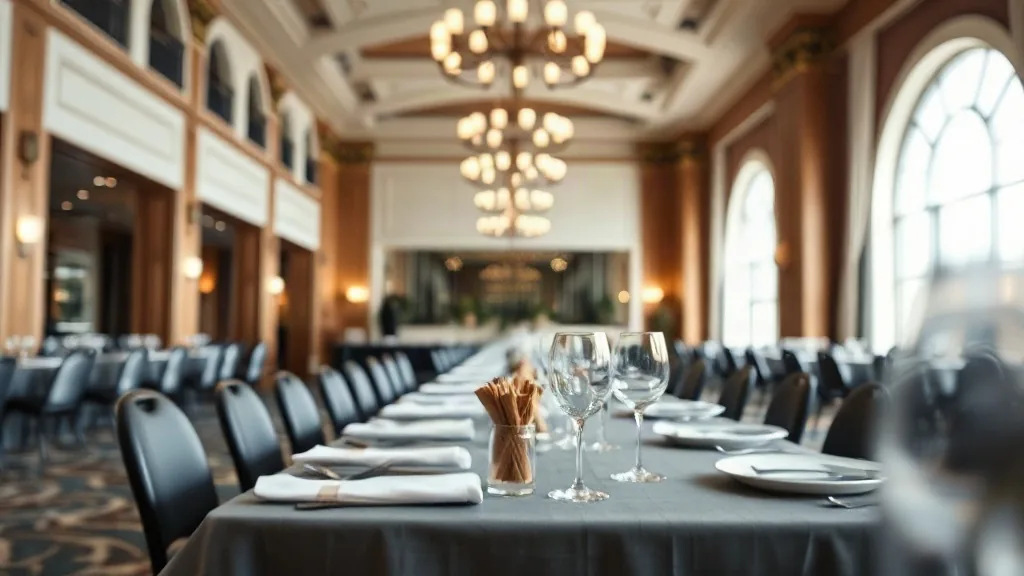
Hotel banquet operations have the most managed review profiles. Most hotel guests don’t separately review the banquet operation on Yelp — they review the hotel itself, and banquet food quality is rarely the subject of a hotel review. This means the banquet food at hotel conference spaces has low review authenticity across the board, and you’re forced to rely on other signals (my site visit, menu tasting, or referrals from planners who’ve worked with that hotel).
Brewery and distillery event venues are interesting: the core taproom reviews are highly organic (craft beer fans are reviewers by culture), but those reviews are for the beer and the bar atmosphere, not the catering. If the venue does catering separately from the taproom, the catering reviews may be a very small subset of the total review volume. Filter specifically for reviews that mention “food” or “catering” or “event” when checking brewery venues.
Urban loft and industrial event venues with in-house catering often have mixed profiles. The venue has been around long enough to accumulate both organic and managed reviews, and the ratio tells you which direction the management has leaned. More authentic profiles tend to produce better catering surprises; more managed profiles suggest the venue is spending energy on reputation management rather than food quality.
What I found when I ran this check on FL venues
My home market in Florida — where I do most of my work — has some interesting patterns. The conference centers in Florida attached to hotels are exactly what I described: low organic review signals on banquet food, so I rely on referrals. The independent event venues in Wynwood and the Tampa Bay arts district have much more authentic profiles, and the good-grammar-error signal in the F&B reviews has predicted two events that significantly outperformed expectations on food.
One specific case: a Tampa venue in 2023, attached to a Spanish tapas restaurant. The Yelp page had 112 reviews; roughly 35% had grammar markers; about half of those mentioned food specifically, and the food language was detailed and enthusiastic (“the octopus was the best i’ve had outside barcelona” — yes, lowercase i, no apostrophe on “i’ve”). I booked a 90-person dinner there based partly on this signal. The catering was the highlight of the event. The post-survey showed 91% F&B satisfaction, highest I’d recorded in two years.
The counter-example
The most valuable counter-example in my data: a Nashville event venue in 2022 with a nearly perfect grammatical review profile and 4.8 stars. Every review read like marketing copy. The one or two rough-grammar reviews were generic positives. I booked it anyway because the price point and location were right and the menu tasting was good.
The catering at the event was fine — not bad, not memorable. Post-survey F&B satisfaction: 73%. Technically passing. But the signal was right: a review profile that polished, for a venue that price, should have produced ecstatic organic reviews if the food was genuinely good. The absence of authentic positive reviews meant the food was exactly what the managed reviews suggested: good enough, nothing more.
Start your venue search with the full US meeting-spaces directory. When you’ve got a shortlist, run the grammar check before you schedule site visits. It’ll take 12 minutes per venue and it’ll tell you more about catering quality than the menu PDF will.
The kitchen-radio check is a useful complement to the review-grammar method: what’s playing on the kitchen radio tells you the kitchen culture in the same way the review profile tells you the catering quality. And the 4pm Tuesday vibe check is where I do both in person on the same visit.
Send me the brief. I’ll do the check on your shortlist and tell you what the review profiles look like.


